A paper published in Nature Cardiovascular Research
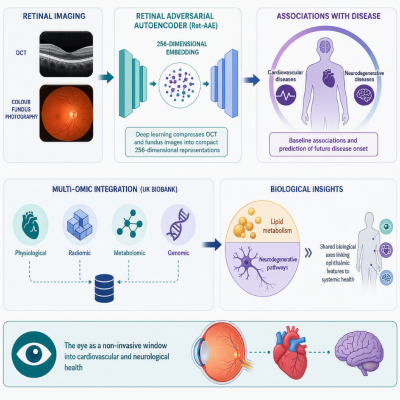
A recent study led by Thomas Julian, published in Nature Cardiovascular Research, explores how retinal images can reveal insights into a person’s broader health. The work develops an AI model, the Retinal Adversarial Autoencoder (Ret-AAE), that learns compact summaries of eye scan data, enabling large-scale analysis using UK Biobank data. The study shows that patterns captured from these retinal images are linked to a wide range of conditions, including heart disease, stroke, Parkinson’s disease and dementia, and can even predict future disease onset.
By combining the retinal image data with genetic, metabolic and physiological information, the work also sheds light on the biological processes that may underlie these connections, with lipid metabolism and neurodegeneration-related pathways emerging as key shared mechanisms. Overall, the study strengthens the case for the eye as a non-invasive window into cardiovascular and neurological health with potential implications for early disease detection.