A paper published in Nature Communications
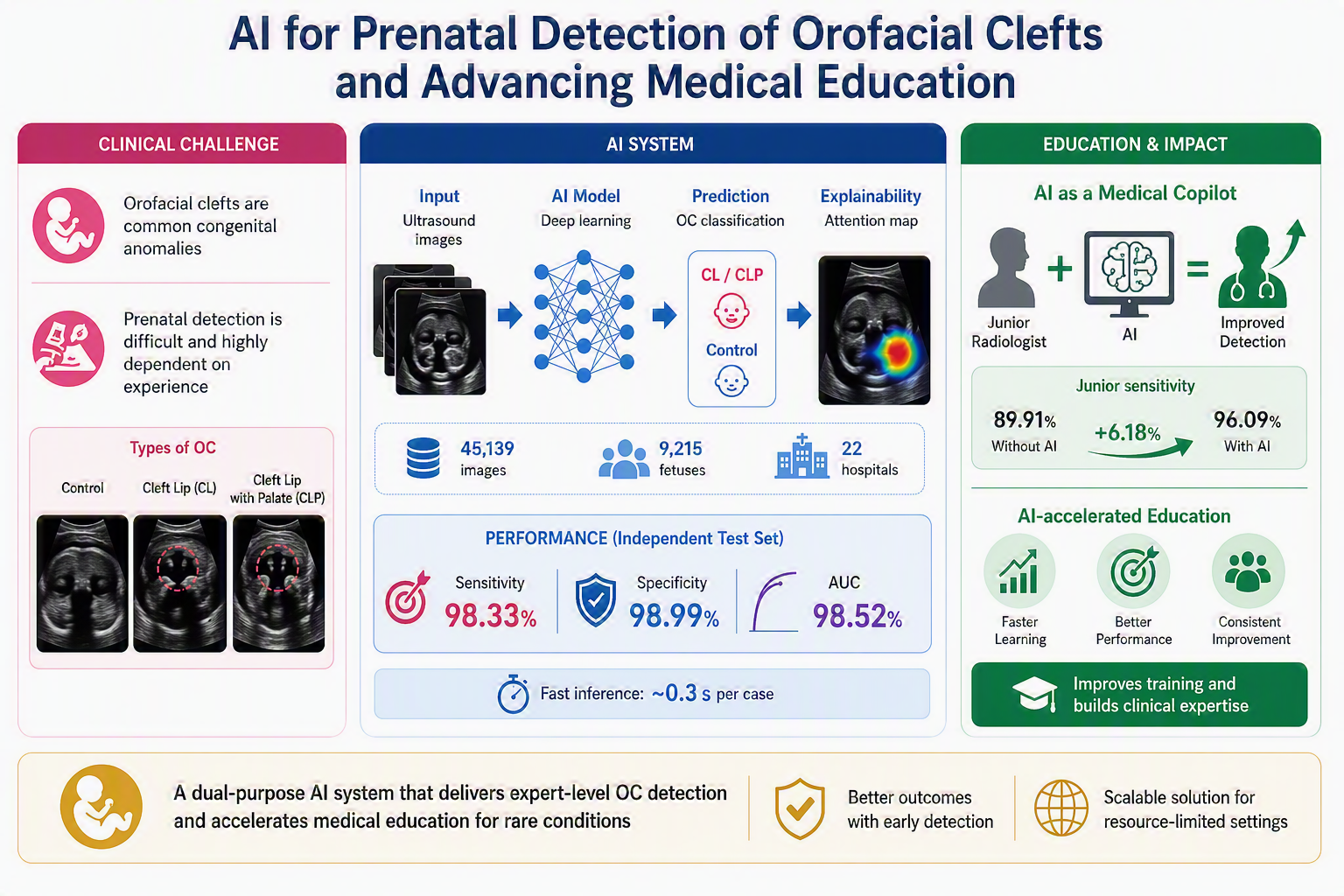
A study led by CIMIM’s Haoran Dou and collaborators, published in Nature Communications, presents an AI system designed to detect cleft lip and palate during pregnancy. This is a condition where a baby’s lip or the roof of the mouth does not fully form, and early detection is important as it allows families and clinical teams to plan care in advance. However, accurate diagnosis can be challenging, particularly for less experienced radiologists.
Trained on over 45,000 ultrasound images from more than 9,000 pregnancies across 22 hospitals, the system achieves performance comparable to senior radiologists while providing results in a fraction of the time. When used alongside junior radiologists as a decision-support tool, it noticeably improved their detection sensitivity, raising it by more than 6%.
Perhaps most encouragingly, the study also found that training with the AI helped junior doctors and trainees learn faster and more consistently than those following traditional teaching methods alone, suggesting that AI could play a valuable role not only in clinical care but also in narrowing the expertise gap between experienced and less experienced practitioners worldwide.